
On Description
the life force of a world

Describe the world. That is one of the writer’s first-order tasks. The world in question could be a city apartment or an abandoned ranch in the desert or your childhood home or a menacing forest or a soccer field or a space station on another planet. Description usually includes details and yet at the same time a pile of details does not necessarily make for a compelling description. It is possible to offer many details of a place or person or experience and actually tell us very little. Because a good description has a life force behind it. A good description contains multiple tiers of reality. It gets at both presence and essence. And, critically, a good description is a collaboration between the tangible world and the consciousness that is doing the describing.
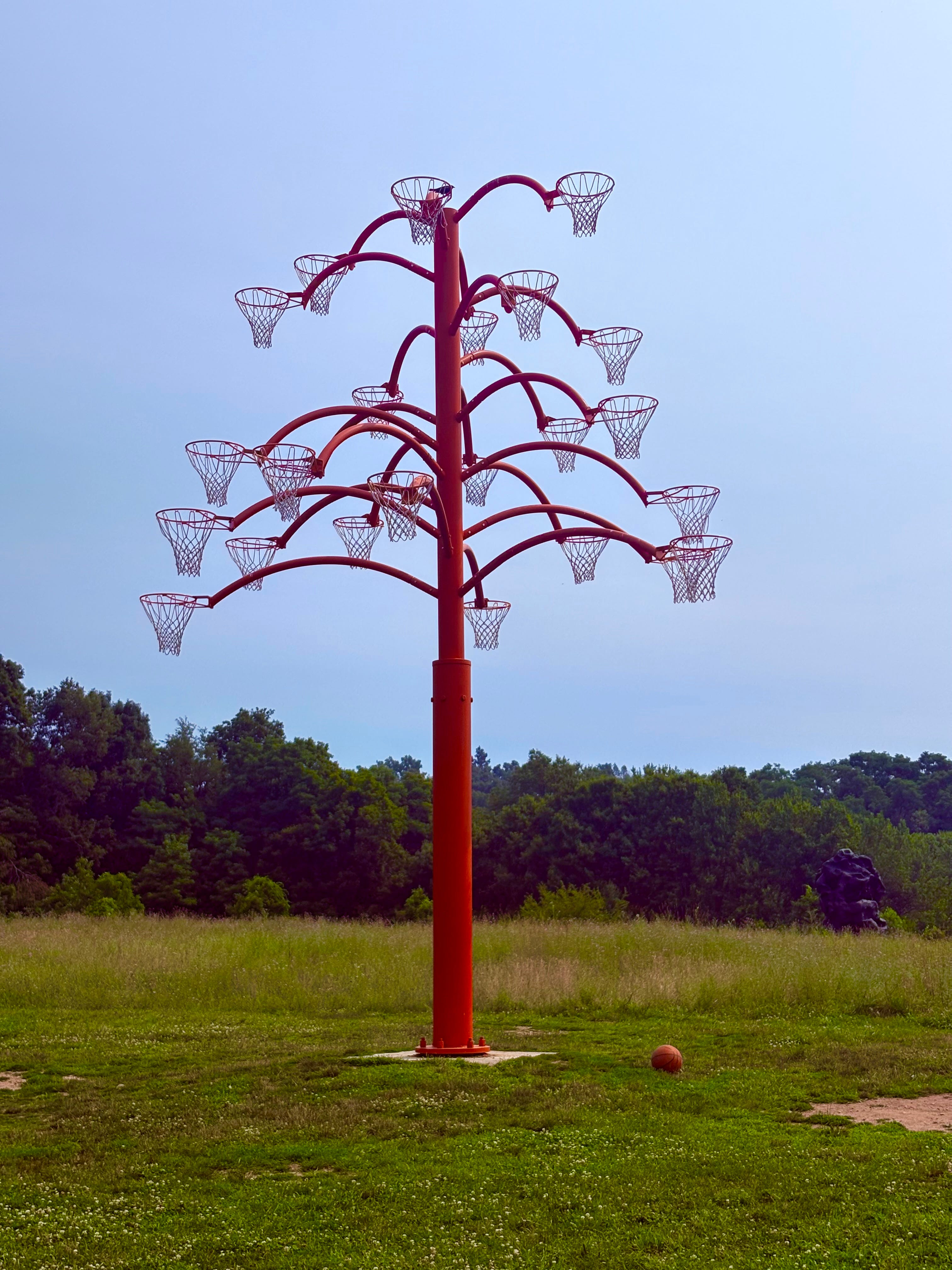
[Art Omi in Ghent, NY]
Take this excerpt from Jeff VanderMeer’s novel Annihilation:
“The tower, which was not supposed to be there, plunges into the earth in a place just before the black pine forest begins to give way to swamp and then the reeds and wind-gnarled trees of the marsh flats. Beyond the marsh flats and the natural canals lies the ocean and, a little farther down the coast, a derelict lighthouse. All of this part of the country had been abandoned for decades, for reasons that are not easy to relate. Our expedition was the first to enter Area X for more than two years, and much of our predecessors’ equipment had rusted, their tents and sheds little more than husks. Looking out over that untroubled landscape, I do not believe any of us could yet see the threat…
Far worse, though, was a low, powerful moaning at dusk. The wind off the sea and the odd interior stillness dulled our ability to gauge direction, so that the sound seemed to infiltrate the black water that soaked the cypress trees. This water was so dark we could see our faces in it, and it never stirred, set like glass, reflecting the beards of gray moss that smothered the cypress trees. If you looked out through these areas, toward the ocean, all you saw was the black water, the gray of the cypress trunks, and the constant, motionless rain of moss flowing down. All you heard was the low moaning. The effect of this cannot be understood without being there. The beauty of it cannot be understood, either, and when you see beauty in desolation it changes something inside you. Desolation tries to colonize you.”
The physical reality of Area X is vividly described: the tower, the black pine forest, the marsh flats. It is a dense landscape, layered with different kinds of ecosystems (presence). There is also a vastness and a mystery we can sense but don’t yet fully grasp (essence). What direction is that wind coming from? And what exactly is the threat? We get a sense of the place’s history: abandoned, desolate, the carnage of past, failed expeditions (tiers of reality) still visible to the narrator, who is critical to this description as it also conveys how the landscape has been working on her (“and when you see beauty in desolation it changes something inside you”). This is a person looking back (“I do not believe any of us could yet see the threat…”) vs. a person experiencing the world in real time. She is narrating from a place of knowledge and this description is infused with that terrible and revelatory knowing. In Wonderbook VanderMeer writes that: “Landscape not invested with emotion or POV is lifeless.” Here we don’t yet know the shape of the narrator’s knowing but we can feel the heavy dread-soaked shadow of it.
There is a particular trick to describing a world we know intimately. I actually find this to be much harder than describing a place I know only loosely or a place that is built almost entirely in my imagination. Because then that collaboration between the tangible world and the consciousness taking in the world, selecting and interpreting detail, comes more naturally; they are dreamed into being alongside one another.
When I started my next novel, Ring of Night, I was struck by how difficult it was to describe the boxing gym that becomes a central place in the story. Sometimes, when I’m describing a world I know really well, a world I am still very much in, it feels a bit like trying to read the label from inside the jar. I have notebooks filled with details from my own gym, from fights, from other gyms I’ve traveled to for sparring. The fighter who stuffed white twists of toilet paper into his nostrils, to staunch a bloody nose, and walked around for the rest of the night with the paper sticking out like little tusks. The time I got a kid’s blood in my eye. The fighter who got his mouthguard knocked out during sparring and, instead of letting his coach pick it up and clean it and put it back in, dropped to his knees and leaned forward like he meant to kiss the canvas and then snatched up the mouthguard with his teeth. The young fighter who is coached by her father; he is deaf and he signs to her from the corner. Somehow she has learned to keep one eye on her opponent and one eye on him at all times.
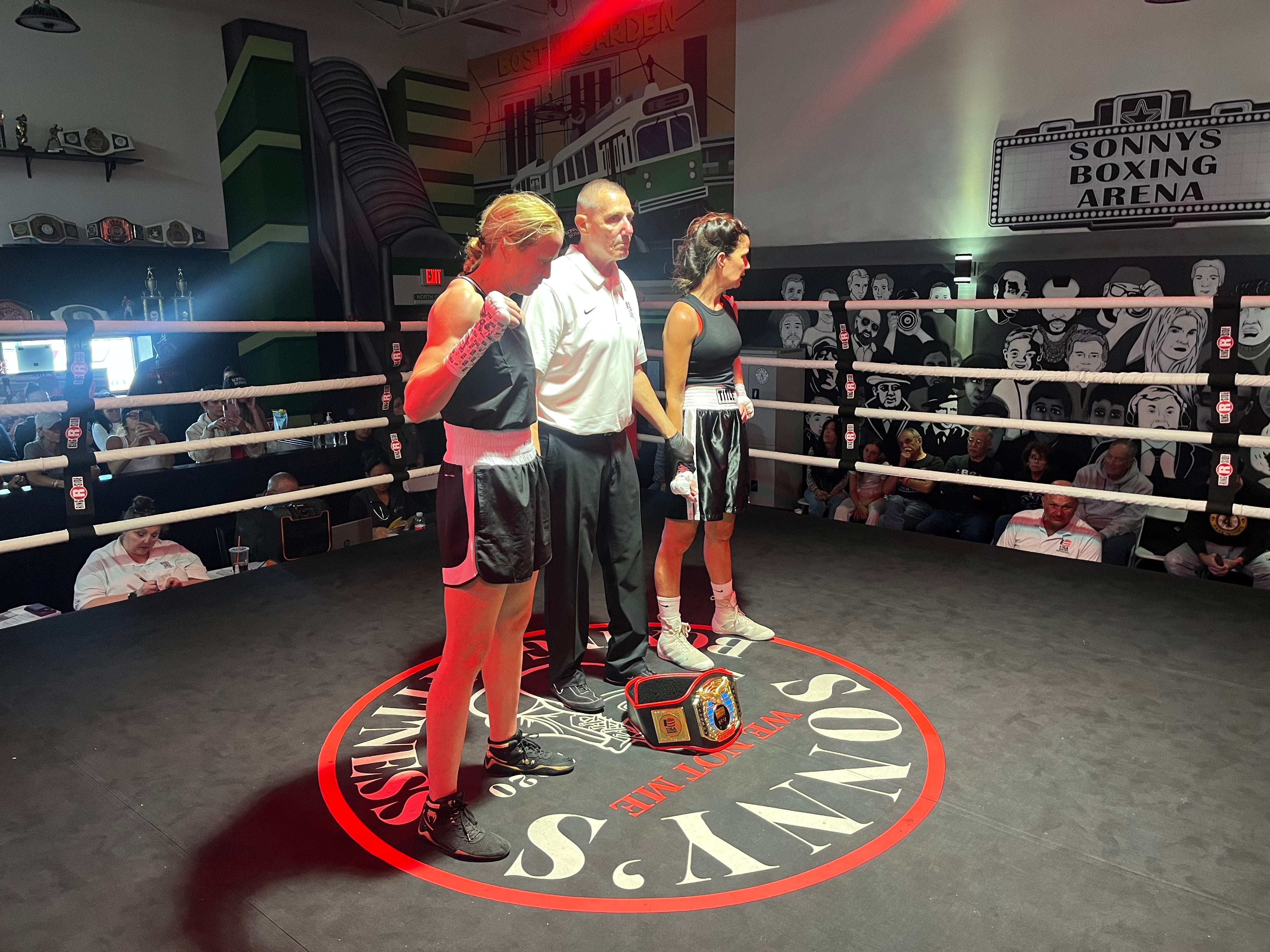
[the seconds before a decision]
But none of these details are attached to the perspective of one of the novel’s central character, a fighter named Tina. How does she gaze upon the world, at this moment in time? How does it feel on her skin? What does she notice? The first time we encounter Tina in her gym it’s early morning, empty, dead quiet (whereas when I’m at the gym it’s late afternoon and packed, a riot of sound). I can remember finally writing this passage and thinking okay, yes, this is what Tina would see: “The mouth of the gym was a wall of light, blotting out her view of the street. She focused on the fine details inside: the slender columns of dust suspended in the air, the deathly stillness of the heavy bags, the white bucket of hand wraps, all rolled into neat little balls, the coveted locker.”
It was interesting and challenging to describe Florida from the POV of someone who was raised there (Tina) and another central character (Fay) who is arriving in Florida for the first time, to search for a missing person. What would Fay notice that Tina would gloss over? What is ordinary to Tina that is strange to Fay? The flatness, I decided. The weather.

[New Smyrna Beach]
I recently read and admired Alfred Jung Lee’s essay “On Description,” where he talks about a lot of things, including attending spousal loss meetings:
“I remember one time when I felt I understood something about one of the other dead spouses. Instead of her spouse, a woman described an electric razor. It had belonged to her husband, and he had used it on many mornings. She used to hate the noise, but now that he was dead, she missed the sound of the stupid thing when she woke up. Somehow, he came alive to me then, though this detail was routine and did not distinguish him. She held the razor in her hand and flipped it on for us.”
Sometimes the most striking and expressive descriptions come at the task a little sideways. Sometimes when we approach the object of description too directly, listing out straightforward detail after detail, it can be a bit like staring straight into the sun; perspective gets blotted out. The description Jung recounts doesn’t give us any factual information about the husband (height, age, eye color). It doesn’t tell us about his interests or his work. We just know he was someone who liked to use an electric razor most mornings. The description is powerful because it is such a specific evocation of the wife’s grief. Of the trivial little things that bug us about the people we’re close to and that we miss wildly when they’re no longer here. So wildly that you might bring an electric razor to a spousal loss meeting and actually turn it on. Grief can be mysterious in that way, surprising. Why, of all things, does she miss the razor so much? You miss what you miss; there is no arguing with the stricken heart. I felt the life force of her grief when I read that passage. I felt the specificity of her perspective. I felt the multiple operational realities (the death of her husband; her memory of their old life together; the world of objects and the histories they hold; the meetings themselves). It made me think of all the mundane, sometimes annoying things I miss about my dad now, like how he always put me on speaker phone when I called, for no good reason, which sometimes made it harder to hear him. Or the state of his cast iron pans. Because I would love to be annoyed by my dad again. Because that would mean that the clock has been run back and that absence has been restored and ordinary life is ordinary life again. It’s the little things, in the end.
The Final Bell—
~ I’m teaching a class on novel revision next weekend. If you vowed to finish your novel this year & you’re feeling a little at sea I am here to help.
~ I’m finally getting to Solvej Balle’s On the Calculation of Volume and it is so delicious and propulsive. I don’t know that I’ll read all the books but verry into this first installment.
~ Paul’s new novel Etna comes out on August 4th! Hudson Valley people: there’s a launch event at Oblong Books on the 4th at 6:30, with the magnificent Jo Ann Beard. Come say hi!
I loved this. Thank you! I'd be interested to learn more of your thoughts about how to edit description. There's presence, there's essence, but then there's also probably a lot of...other stuff. One thing that good description does well is gives you just enough. How do you establish that balance?
“Presence and essence”!! Yes!! Thank you for sharing your thoughts on this. Sorry I’m too far from Oblong. Hope there will be other events more south! ❤️