
On Pain
my all-night odyssey in the ER & turning setbacks into keys

Don’t you worry about getting hurt? This is a question I get asked a lot when people find out I box. The truth is I have accumulated a handful of injuries through the years and not a single one came from a punch. I tore my meniscus while playing with Oscar in a park (the grass was wet and I slipped). I tore a disc in my lower back while moving an absurdly heavy piece of furniture. Twisted an ankle falling down a flight of stairs.
Being alive can be a dangerous enterprise, is what I’m trying to say.
Add to that list of injuries: in the last week of August, during team strength training, my right hand got crushed between two very heavy weights. It was one of those freak fluke accidents that could have been easily avoided if I had been moving with a little more caution. I felt a lightning-strike of pain. I looked down at my right hand and one of my fingers was in a shape I did not recognize. I thought I could see a bit of bone. I won’t go into all the gory details but there was a lot of blood. I started to feel nauseous and light-headed and before I knew it I was wilting down onto the black floor mats.
My coaches got my hand wrapped up in gauze and tape. Teammates brought over water, ice, Advil. Once my hand was wrapped up tight the wooziness vanished. My body suddenly felt a little safer, a little less exposed. I got up. We were a little more than halfway through the strength program. I finished the workout with everyone else. I’m not sure why. The remaining exercises were lower-body and there was nothing wrong with my legs. That was what I remember thinking at the time. Also I was no longer in a tremendous amount of pain.
One of my coaches urged me on to the ER. She suspected I had a broken finger and also needed stitches. My gym is in the Berkshires and I live in the northern Hudson Valley, down the street from a hospital.
“I would rather be close to home,” I told Paul once I was on the road. He was worried about me driving back to New York. Maybe I should just go to the closest ER? “And besides it doesn’t hurt as much as you would think.” At the ER I learned I’d broken my hand in two places and did indeed need stitches. I had an allergic reaction to the lidocaine they gave me and passed out cold for several minutes. When I came back around I did not initially know my name, where I was, or what year I was in. Also: apparently I thought Barack Obama was the president (all this was narrated to me later by one of the nurses; I have only a vague memory of waking up and trying to speak and not being able to).
The ER was in a state of chaos. I was in the waiting room for five or so hours before I was brought into a kind of triage area with a nurses’ station and various curtained rooms and another row of chairs for waiting. Not so much progress as moving a layer deeper into the inferno.
The nurses’ island was a square of plexiglas and faux wood. The surfaces were crowded with black desktops, papers, binders, a half-dead philodendron. Pamphlets for hospice and opioids and family planning. A grey divider wall halved the island. The wall was papered with cheat sheets (CODE SEPSIS for an adult patient) and a child’s drawing of a unicorn. I overheard two nurses vent about their struggle to get a patient admitted to the ICU. He can’t stay here. His lactic acid is through the roof.
I would later learn the ER was dealing with numerous ambulance-level emergencies that night, including two car accidents and a woman having a psychotic break (I never saw her but could hear her screaming down the hall). An older woman was waiting back there too. She had a cane and looked very frail. At one point I saw her cough blood into a cloth handkercheif. I was so relieved when her daughter came to wait with her, bearing a pillow and a fleece blanket. There was one doctor on shift. I kept thinking about what was going to happen to this place once the medicaid cuts fully kick in.
A nurse would come by once every hour or two to take my vitals and ask where I was on the pain scale. I never know how to answer this question. What do you have to be feeling in order to say ten? I said maybe I was at a three. “Are you sure?” he said, staring down at the blood-soaked gauze wrapped around my hand.
I have a weird relationship to pain. I inflicted a lot of pain on myself when I was younger. A lot of that pain made me feel better for a time and then much much worse. I wouldn’t say I like pain, or that I wish to be in pain. Chronic pain of any sort is one of the most emotionally grinding things a person can experience. But it is also true that the right dose of pain can still make my brain hum in a beautiful-feeling way.
I ended up being in the ER for nine hours. I came home around five in the morning, slept for a few hours, got up and went for a run. I felt ablaze with energy. I bumped into a neighbor and, after I explained what happened to my hand, which was freshly stitched and bundled in gauze, she asked me if it hurt to run. “I really doesn’t!” I replied cheerfully, and she looked at me like I was out of my mind. At home Paul kept asking me if I was tired, given that I’d been in the ER all night, but somehow I wasn’t. I worked for hours unbroken, my focus sharpened to a fine point. Eventually I realized I was high as all get out on adrenaline, that the pain had done something to my brain. Had done something so amazing I could not register that I was, in fact, in pain at all.
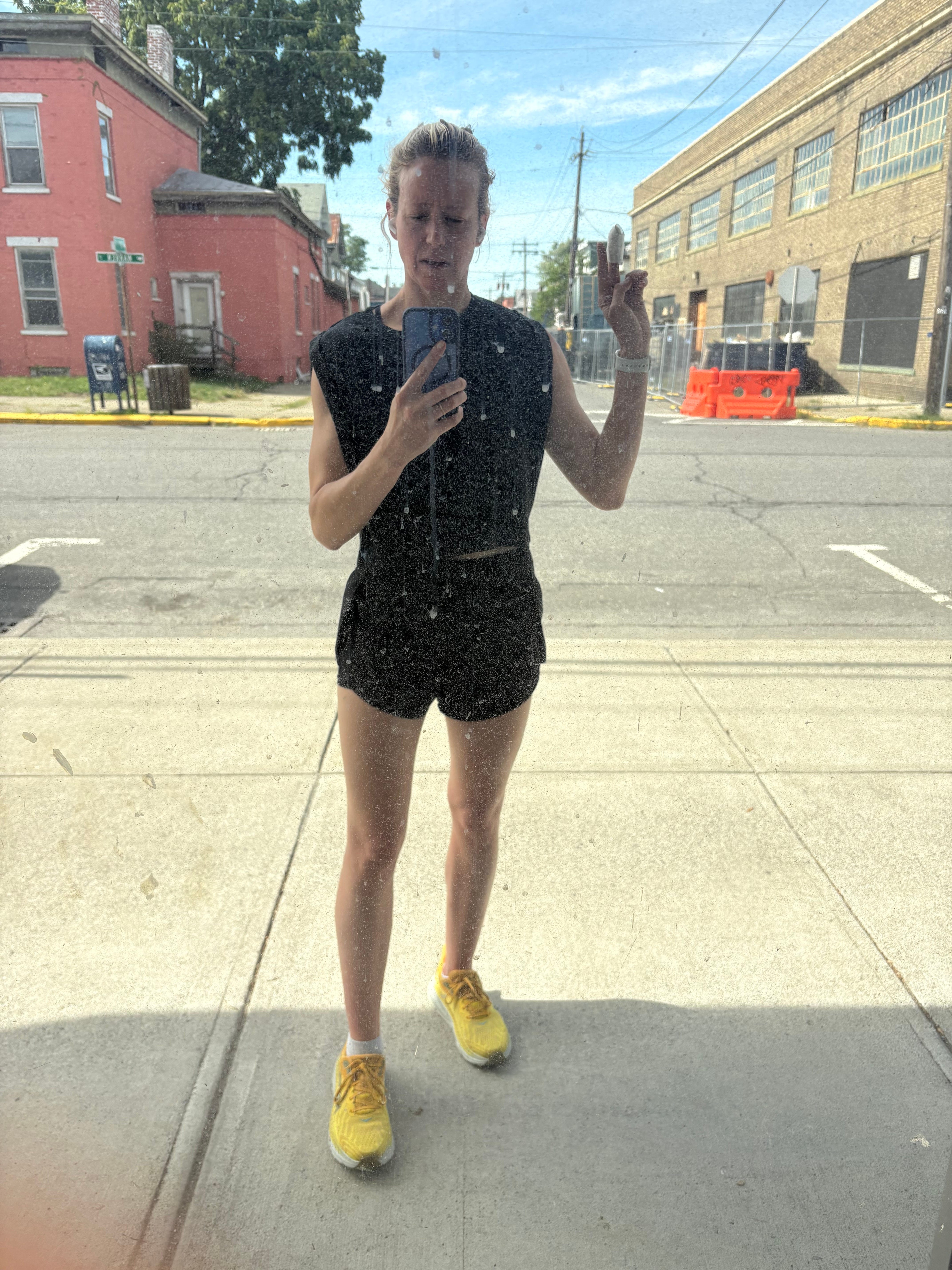
Boxing has taught me to treat myself with so much more kindness. I am really proud of how far I’ve come both physically and mentally, and I know that progress depends on me taking exceptionally good care of myself. And also: boxing is a sport where pain is, in some ways, central. I’m not even talking about the punches, about the ways we hurt each other in the ring. The conditioning one must acquire in order to fight: that piece honestly takes more people out than anything else. It hurts. Some people die a few times on the assault bike and are like no thanks. But I knew from the start that I could tolerate the pain. I could tolerate it and I would like the way I felt once I was on the other side and after that feeling faded a little I would want to get back to it as soon as possible.
In the ER graduating from a very hard chair to a stretcher felt like a miracle. The older woman was on a stretcher now too, her daughter asleep in a chair, the cane tipped against a wall. I never got to a room. My hand was set and stitched up in a hallway. I remember asking the doctor how long it would be before I could punch with my right hand and she said, “Four weeks.” I started to cry. She asked me if I was in pain and I told her I was scheduled to fight on September 14th. “I understand,” she said. Turns out her brother used to be a MMA fighter.
I’m two weeks in now and will not be fighting this weekend as planned, a sentence that breaks my heart to type. But there is just no way: I still have stitches, I still can’t make a fist. I am scheduled to fight in late October and am determined to be ready in time. Injuries are part of being an athlete and also they suck; it is not my feeling that every situation has an upside. But I have been thinking about how sometimes a setback can turn out to be a key.
Writing books taught me this. Anyone who has ever worked on a novel for a long time has likely experienced the gutsick feeling of realizing the narrative architecture you’ve spent years honing is flawed at the root, or that character you’ve tried so hard to bring to life must be cut. And yet often these setbacks, which can feel so crushing in the moment, end up being the key that unlocks the door we must pass through in order to finish the book.
Or that time my laptop died and took with it a few new stories that I believed would become the core of my next collection. I had to retype the drafts from memory and they were so much better for it.
So I feel the task before me now is to discover how training with only my left hand for a bit longer can become a key. I’ve been spending more time working on footwork, head movement, and my jab (aka the most important punch in boxing). Because I can only punch and defend with my left hand I’ve been getting more creative with my combinations and my defense. Rolling the lead hook and closing the distance with taller opponents. Or using my feet and my jab to keep my opponent at the end of my range. Throwing more check hooks. And I can still run and train lower body strength and core and do the kind of conditioning work that hurts.
Another possible key is that I’m getting to practice some life skills too. Like asking for help. I am not great at asking for help! And then sometimes feel a little aggrieved that I have not magically gotten the help I never told anyone I needed. The un-beautiful kind of pain can be so lonely. The key here is allowing someone else to open the door.
I am here to say anything that teaches you to ask for help is totally worth it.
That brought back several ER memories. I have been in one so many times that my friends tell me that I should write a book called “Emergency Rooms of the World”. A few have been London, Frankfurt, Arlington (VA) and Traverse City, MI.
When I got a compound spiral fracture of the tibia and fibula while carrying my dog down the back steps, I thought I was going to have a bad bruise. Imagine my horror when I looked down and saw bones sticking out. I immediately put my hands around my calf and waited for the ambulance. Since I didn’t cry or shout neither my partner or neighbor thought it was anything but a bruise. I just sat on the step, patiently waiting for the ambulance to arrive. The last thing I remember was several guys putting a temporary splint on my leg. I awakened in the hospital at 2pm having already had surgery. I was in the ER, but for once had no memory of that part of it!
I saw that you taught in Baltimore, which is where I grew up. Your grandmother Elizabeth was my grandmother’s 1st cousin and one of her very best friends. Her name was also Elizabeth. Elizabeth Egerton Conklin.