
On Taking Notes
Edits on the new book are in! Here's how I'm dealing!

In fights I sometimes have a hard time hearing my coaches. I mean this literally: they are shouting various instructions from ringside, and then elaborating on these instructions in the corner, and I feel like I’m listening through a waterfall. The adrenaline, the crowd, the physical intensity of the bout. All that has a way of blotting out the steady, reliable voice of the coach who is trying to provide essential edits in real time.
In my last fight, I was better able to hear what my coach was telling me in the corner and to carry those edits into the next round and the next, which felt like a breakthrough. Sometimes your coach will tell you to do something that seems impossible but you have to trust that they are seeing things you cannot. Possibilities, openings. They have to focus on the most essential edits–you only get a minute between rounds, and some of those precious seconds are spent getting the fighter water and helping them to breathe and cool down–and they have to not only tell you what to fix but how to fix it. You’re getting hit coming in. Double jab with your head off the line. Earlier this year, after Teofimo Lopez lost a fight to the expertly elusive Shakur Stevenson, Lopez’s coach–who is also his father–was roundly criticized for his corner work. “Hit him, bro,” the father kept saying as though that was not what his son had been trying and failing to do out there. I’m pretty sure Teofimo Lopez knew he was in a fight! If he could have hit Shakur Stevenson he would have.
There is a real art to corner work, but also some fighters are not coachable. They think they know better. I remember a guy who came to our gym once and then stormed out when the coaches did what they are there to do: correct, instruct, guide.
Some writers take pride in not being coachable, in not ever taking notes, which feels unhinged to me. I love getting edits. A good editorial letter deepens my relationship to the project. It brings me closer to it. It allows me to see the dimensions that I could not see from the center of the storm. “Good” is an important caveat here: I’ve seen editorial letters that are the literary equivalent of “Hit him, bro” or that project an entirely different book onto the one the writer has turned in. I have been lucky to work with two outstanding editors at FSG and my current editor, Jackson Howard, writes editorial letters that leave me feeling like the exact right kind of help has arrived at the exact right moment.

[Midori notebooks are my hands-down favorite]
In the revision class I’m teaching this semester, I promised my students that I would keep them updated on what was happening in my own writing life and so when I told them I’d gotten edits back from Jackson they were curious to know how I felt about the notes. Did I like them? What would happen if I liked some and not others? Did I have to take all the notes, or could I pick and choose? Did I worry about having to “compromise my vision?”
There is an art to taking notes. One extreme is the writer who is totally closed to outside ideas; they are too deep in a trench of their own making. The other extreme is the writer who is highly suggestible and too eager to please. They feel like they can’t say no, or that if they disagree they will make people unhappy. You cannot be afraid to disagree. So, as a starting point, you have to know yourself and your work and what you want. This is one reason why I believe in having as few readers as possible for a work-in-progress until it reaches a certain point. Notes can be really confusing–derailing even–if they come too soon. Let it be yours and yours alone for a while. This thing about “compromising your vision” comes up a lot with students and I find the worry a little puzzling. Like: don’t ever write things that you don’t believe in! Problem solved. But if you don’t know what you do believe in, for a particular project, then it gets harder to make those distinctions. Artful edits–and artful incorporation of edits–should help a book to become more itself.
For me edits fall into 4 buckets: 1. I was hoping deep down that I would not have to think about this but clearly I must; 2. Perfect articulation of the problem + gorgeous solution; 3. Perfect articulation of the problem + I need a different solution; 4. I have a totally different perspective on this.
The “perfect articulate of the problem + gorgeous solution” are the edits that feel like little gifts; I take them no questions asked. This is by far the easiest category to deal with. The edits that compel me to think about some aspect of the book that I had been willfully ignoring usually signal more exploratory work needs to be done. There is something that I haven’t quite faced up to. “Perfect articulation of the problem + I need a different solution” just means I want to approach the question from a different direction.
I think it was bucket 4–the edits where I have a totally different perspective–that my students really wanted to know about. I mean, most editors do not expect their writers to take every single edit so one solution would be to simply ignore the edits that fall into bucket 4. But time and experience has taught me that these edits can usefully spark curiosity, questions, conversation. I have a totally different perspective on this AND that perspective does not seem to be coming across to you. What would it look like for this perspective to be clearer, more fully embodied?
The space for conversation is a good indicator of a generative, supportive editorial relationship. Edits should be a dialogue. It is actually the back-and-forth that deepens my relationship to the imagined world. Getting to talk through my decisions and why I made them and how I might re-approach some of them with a smart, invested reader is so clarifying. And in the end the solutions have to come from within the writer. We are the only ones who could have imagined our world and are therefore the only ones who can reimagine it. The same is true in the ring. My coach can tell me to double jab with my head off the line all day but I am the only one who can move my body in a particular way. In its best form taking notes is when your belief in yourself and your belief in another person and their belief in you all join forces.
Otherwise it’s the ass-end of winter in the northeast. It’s not as cold but also still cold enough and grey and damp. Even beautiful places look kind of ugly. Little green shoots are starting to appear in the front yard but spring still feels far away. This is the hardest stretch of winter for me, but also it feels like a good time to take notes, to do that alchemical work and emerge with a transformed thing.
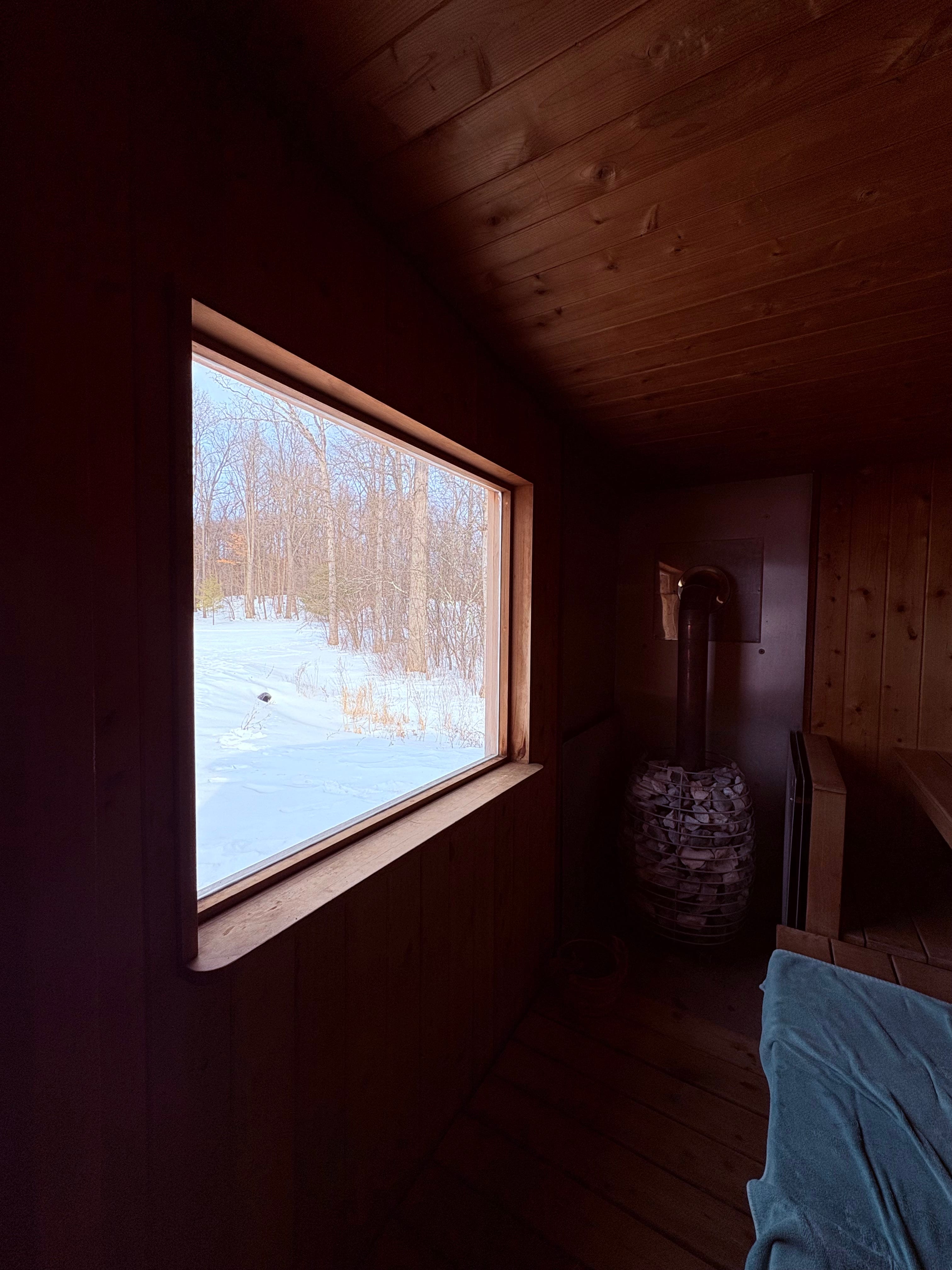
[Saunas + cold plunges have been getting me through winter. Highly recommend Big Towel if you’re within striking distance of Germantown, NY or Kingston!]
The Final Bell:
I’m teaching two classes in April via The Work Room at the Shipman Agency: The Speculative Short Story: How to Imagine a World on Sat April 14th & On Intuition: Finding Our True North on Sat April 18th.
If you’re in the Boston area: I’ll be reading at MassArt on March 24th.
Last but hardly least: my favorite writing buddy Oscar was featured in a NYT piece on writers & their dogs! (My husband Paul contributed a gorgeous essay to the recently published anthology The Best Dog in the World).
Love this, Laura! My favorite story of "edits" from the corner comes from Teddy Atlas who held a cell phone up to this fighter and said, "It's your son. He wants to know why daddy doesn't want to be a champion anymore."
The four buckets—yes! So well put…